Skip to content
English
  • There are no suggestions because the search field is empty.

Autel Evo Max4N Into and Operation

undefined-Aug-17-2026-03-20-00-8135-PM
The payload
Starlight night vision 2.3 MP, 0.0001 lux recognition, ISO to 440,000
Wide (RGB) 50 MP, 1/1.28" CMOS, F1.9, 85° FOV
Thermal 640 × 512, −20 to +150 °C / 0 to +550 °C
Laser rangefinder Target coordinates and slant range
Perception mmWave radar, 720° obstacle avoidance
Why it matters at night
Every sensor looks at the same scene through the same gimbal. Switching between them is a control input — not a payload swap, not a second sortie. The aircraft stays on station while the operator changes what the scene is made of.
Built for the people working after dark in rural country: houndsmen and hunting outfitters, search and rescue, county law enforcement, volunteer fire, and producers checking stock at night.
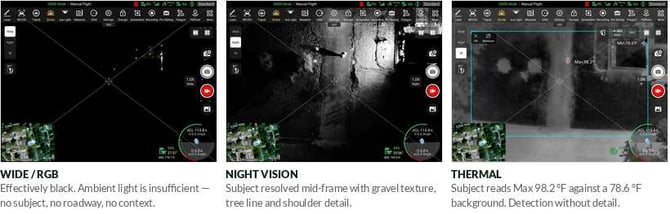
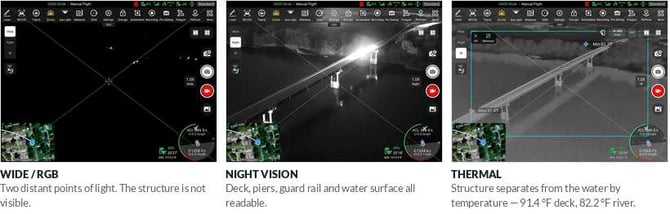
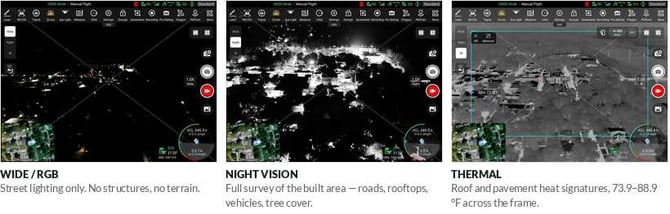
Same frame, three sensors
No repositioning between captures. Only the sensor changed.
Person on foot · 113 ft AGL
Bridge and river · 349 ft AGL, 1,324 ft slant range
Town overview · 349 ft AGL
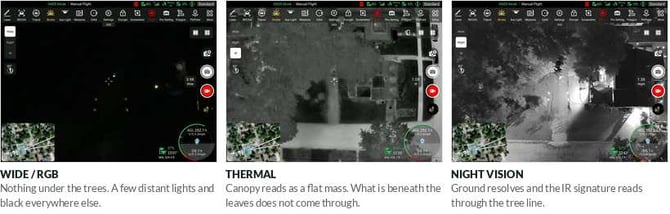
The operational read. Night vision gives you identification — what a thing is and what is around it. Thermal gives you detection — that something warm is present, through smoke and light foliage, with a temperature attached. Neither replaces the other, and RGB contributes nothing after dark.
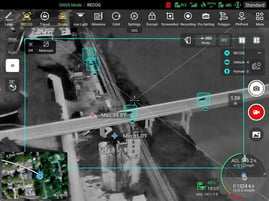
Onboard AI detection on the thermal feed
RECOG running live at 349 ft AGL, 1,324 ft slant range.
 
What is on screen
Cyan boxes are aircraft-generated. The RECOG panel tallies classifications in real time — Vehicle 4, Human 0 — while the thermal palette holds spot temperatures on the same frame: 94.8 °F maximum on the bridge deck, 81.0 °F minimum on the river below.
Why it matters
  • Detection runs on the aircraft, not the controller
  • The operator watches a count instead of scanning a moving frame
  • Vehicle and human classes are separated, so a road full of parked cars does not mask a person walking through it
  • It runs on the sensor that sees heat — the sensor that finds living things at night
Honest limitation. Classification degrades with range, angle, and thermal contrast. Treat the count as a cue to look, not as an authoritative headcount. Under heavy canopy, thermal detection falls off sharply.
The IR strobe — and why only one sensor sees it
Marking what you need to keep track of, so the aircraft never loses it.
What it is
A small battery-powered beacon — worn on a shoulder or helmet, or clipped to a dog's collar or vest. It emits pulsed near-infrared light just past the red end of what the human eye registers. On the ground it looks switched off. To a near-IR sensor it is a bright, unmistakable flash.
The beacon we run
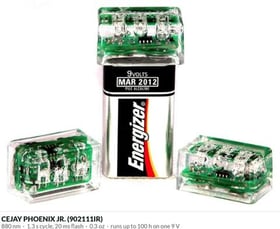
Cejay Phoenix Jr. (902111IR) — the infrared combat identification marker in US service since 1984, NSN 5855-01-438-4588.
Wavelength 880 nm
Flash cycle 1.3 s, fixed
Flash duration 20 ms, fixed
Emitters 3 LEDs, 240° × 360° coverage
Power 9 V, up to 100 h runtime
Size / weight 1.19" × 0.74", 0.3 oz
Why night vision sees it and thermal does not
Different regions of the spectrum. No setting changes this.
Sensor Band Sees strobe
Wide / RGB 0.4–0.7 µm No
Starlight NV ~0.4–1.0 µm Yes
Thermal (LWIR) 8–14 µm No
Thermal images heat at wavelengths ten times longer than a strobe produces. It cannot see the beacon at all — only the body heat of whoever is wearing it, which is what a canopy blocks.
Field notes
  • Mount high and facing up. Top of the shoulder, helmet, or the top of a dog's vest. Chest and flank placement is invisible from overhead.
  • 850 nm: longer range, faint red glow up close. 940 nm: fully covert, shorter range.
  • Assign distinct blink codes, or a group reads as identical dots.
  • Anyone else running night vision sees your markers too.
  • Glint tape is not a substitute. It is passive and needs an IR source beside the observing sensor. The 4N carries no illuminator.
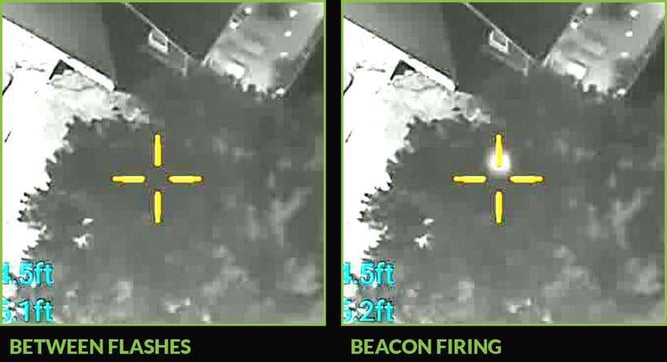
  • Know the duty cycle. 20 ms once every 1.3 s is roughly one frame in forty — a distinct repeating flash live, but most single screenshots catch it dark.
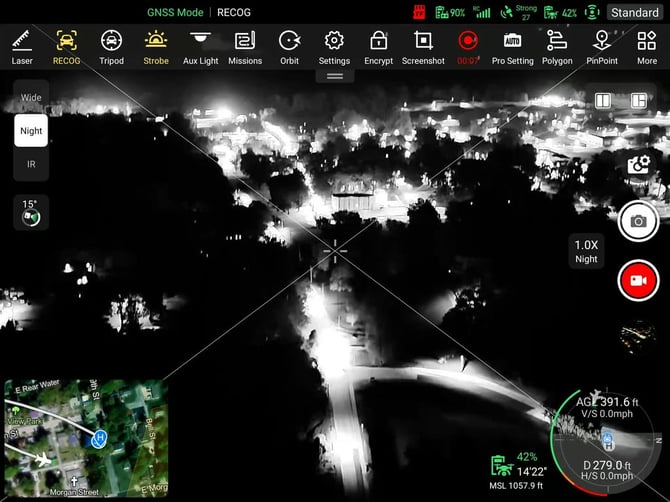
Same tree line, all three sensors · 252 ft AGL
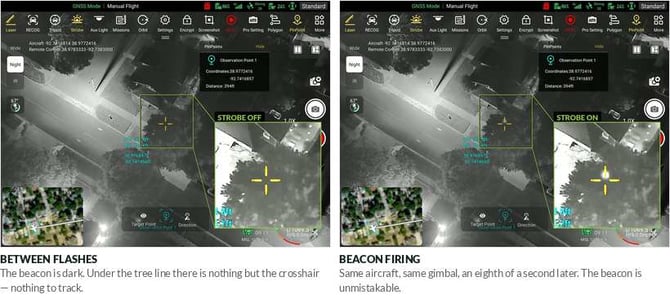
One blink, two frames
Night vision · 395 ft AGL · 394 ft to the marked point · the captures are 0.13 seconds apart
Magnified view of the boxed area in each frame above. Identical contrast stretch on both — no other adjustment.
What you are looking at
A ground beacon under tree cover, seen from the aircraft on the night vision sensor. Both magnified views carry an identical contrast stretch so the comparison is fair — nothing else has been altered.
Measured off this clip, the beacon flashes roughly five times a second. Every flash is a fresh position fix.
Why this is the whole point
The dark frame is what every other sensor on the aircraft sees, all the time. RGB has no light to work with. Thermal cannot resolve a body through that canopy, and cannot see the beacon at all.
The bright frame is what makes overhead tracking possible: a marked position you can act on, refreshed several times a second, from a beacon nobody on the ground can see.
Where this earns its keep
One aircraft, one operator, and a handful of beacons.
Hunting dogsHoundsmen & outfitters
Strobe on the collar or vest. The drone holds overhead while the dog works cover, and the handler sees exactly where the dog is instead of guessing from a beeper or a signal that dropped out. Useful on night hog and coon hunts, and for recovering a dog that has gone quiet, treed out of earshot, or crossed onto ground you cannot follow onto quickly.
A GPS collar gives you a dot on a map. This gives you eyes on the dog and the ground around it — whether it is moving, what it is into, and whether anything else is there.
Livestock & propertyProducers
Thermal finds stock in the dark across a section of pasture in minutes. Night vision tells you which animal it is and whether it is down. Strobes on gates, equipment, or a helper's truck give you fixed reference points when everything looks the same from 300 feet.
Search & rescueGround team accountability
Strobes on every searcher, coded by team. The aircraft keeps accountability of the ground element under canopy where thermal loses them, marks a found subject's location for incoming crews, and confirms which sectors have actually been walked.
Law enforcementContainment & overwatch
On a perimeter, everything warm looks alike on thermal. Strobes on your own officers separate friendly from subject at a glance, so the aircraft can call movement without hesitating. Also useful for K9 track overwatch and for marking the containment line itself.
Fire serviceNight operations
Crew tracking on a line after dark, marking apparatus and anchor points, and scene size-up before committing people. Thermal reads the fire behavior; night vision and strobes keep track of the people working near it.
Before you rely on it. Fly the setup you plan to use, at the altitude you plan to use it, over the cover you actually work in — and confirm you can see every beacon before it matters. Canopy density, altitude, and sensor gain all move the threshold.