![ASD_icon_4c.png]](https://knowledgebase.agrispraydrones.com/hs-fs/hubfs/ASD_icon_4c.png?width=50&height=50&name=ASD_icon_4c.png)
1. Overview
The Speaker and Spotlight is a dual-function payload for the Autel EVO Max series that mounts to the
aircraft's top PSDK interface. It combines a 60-watt directional searchlight with a 10-watt broadcast
loudspeaker in a single quick-release module, giving a crew both illumination and one-way voice
communication from the same airframe.
The payload is aimed primarily at public safety, emergency response, and after-dark inspection work.
Because it occupies the top interface rather than the gimbal, it does not displace the aircraft's primary
camera — a 4T keeps its thermal and zoom sensors, and a 4N keeps its starlight night sensor, while
the spotlight and speaker operate alongside them.
The defining feature is follow-gimbal-pitch. The spotlight tracks the camera's pitch automatically, so
wherever the operator points the sensor, the beam follows. In practice this means one pilot can
search and illuminate at the same time without a second operator managing the light.
Figure 1 — Payload Module
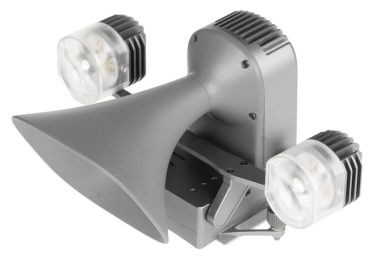
Speaker and Spotlight module. Twin LED heads flank the horn-loaded loudspeaker; the quick-release plate mates to the EVO Max top PSDK interface.
Figure 2 — Installed Configuration
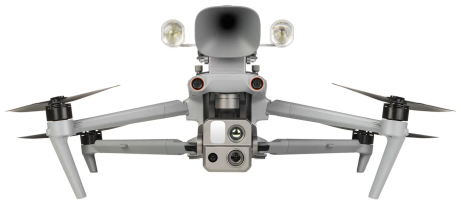
Module installed on an EVO Max airframe. The payload sits above the fuselage and clear of the gimbal, so the primary thermal, zoom, or starlight sensor remains fully available.
2. Published Specifications
The figures below are the manufacturer-published specifications for the module.
2.1 General
Electrical interface: PSDK (top-mounted)
Dimensions: 145 x 116 x 83 mm
Installation: Standard quick-release mount
Compatible aircraft: Autel EVO Max 4T, 4N, and 4T XE
Operating temperature: -10 C to 50 C (14 F to 122 F)
Storage temperature: -20 C to 60 C (-4 F to 140 F)
2.2 Spotlight
Power: 60 W
Beam angle: 14 degrees (narrow / focused)
Brightness levels: Three, operator-selectable in flight
Rated lighting distance: 50 m / 100 m / 150 m (164 / 328 / 492 ft)
Coverage area at distance: 113 sq m / 471 sq m / 1,063 sq m
Central illuminance: 30 lux / 7 lux / 3 lux
Adjustable angle: +30 to -90 degrees, follows gimbal pitch
2.3 Speaker
Power: 10 W
Sound pressure level: 114 dB at 1 meter
Broadcast distance: 300 m or greater (984 ft)
Broadcast modes: Live microphone from the controller, or pre-recorded audio files
3. A Note on Conflicting Specifications
Several online listings advertise this payload at "60,000 lumens." That figure is not correct and
appears to originate from a misreading of the 60-watt power rating. Autel does not publish a lumen
output for this module; it publishes illuminance at distance in lux, which is the more useful number for
mission planning anyway.
Speaker output is also quoted inconsistently, most often as either 114 dB or 120 dB. The
manufacturer specification sheet lists 114 dB measured at one meter. Customers comparing this
payload against competing systems should confirm that the competing figure is also measured at one
meter, since sound pressure specifications quoted at unstated distances are not comparable.
Agri Spray Drones quotes the manufacturer specification. If a mission depends on a specific
illuminance or audibility threshold, we recommend a demonstration flight over representative terrain
rather than reliance on any published number.
4. Understanding the Illuminance Figures
The three lighting distances are not brightness settings in the sense most operators expect. They
describe the same fixed 14-degree beam measured at increasing range, with output stepped to
match. As range increases, the lit circle grows and the light landing inside it thins out.
For context, 30 lux is roughly the light level of a residential street under streetlights, and 3 lux is
comparable to deep twilight. At the 150-meter setting the beam covers just over a quarter acre, but at
an illuminance where the human eye sees shape and movement rather than fine detail.
The practical consequence is that the spotlight is a target-marking and close-work tool, not an area
floodlight. For wide-area search, the correct technique is to search on thermal or the starlight sensor
first, then bring the spotlight onto a specific contact once located.
Figure 3 — Output Comparison
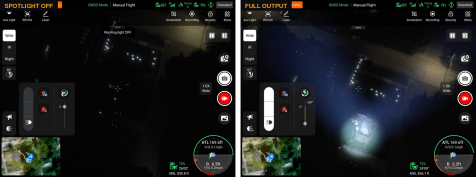
Same position and gimbal angle, spotlight off and at full output. 169 ft AGL, no moon, no ambient light. Note the lit circle relative to total field of view.
5. Field Notes — ASD Night Evaluation
The following observations come from an ASD night flight over mixed rural terrain, structures, and
open water in Cooper County, Missouri, with no moon and no meaningful ambient light.
5.1 What Worked Well
• Ground detail beneath the aircraft resolved cleanly at 169 to 282 ft AGL at full output, with
structures, vegetation, and terrain readable on the standard wide sensor.
• Follow-gimbal-pitch held the beam on a fixed point through repositioning and orbits without pilot
input to the light itself.
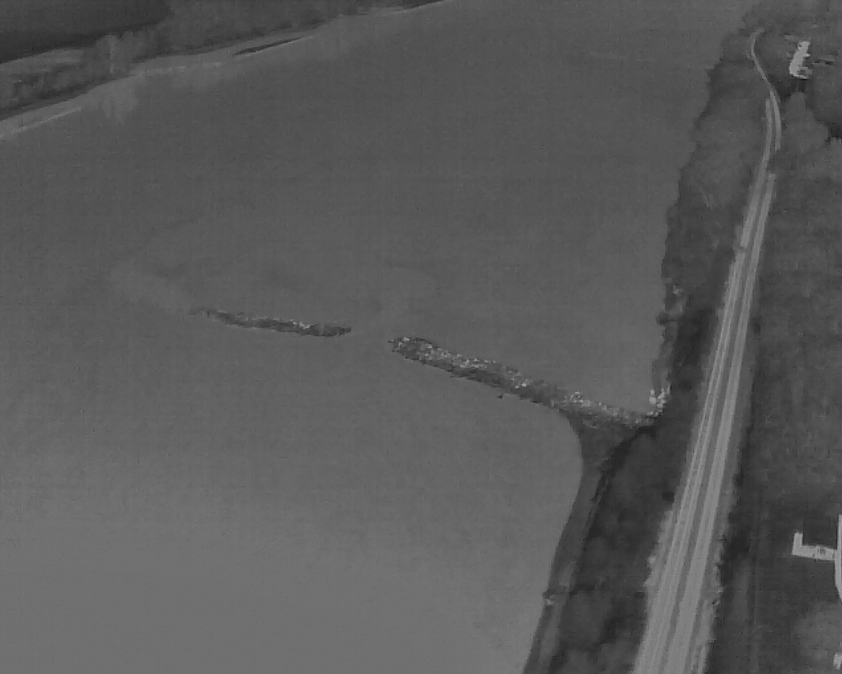
• Contacts on a mid-river sandbar were located first on the starlight night sensor, then marked with
the spotlight — the correct sequence, and it worked exactly as intended.
• The beam remained visibly useful against structures well beyond the rated 150 m, though as a
marker rather than as working illumination.
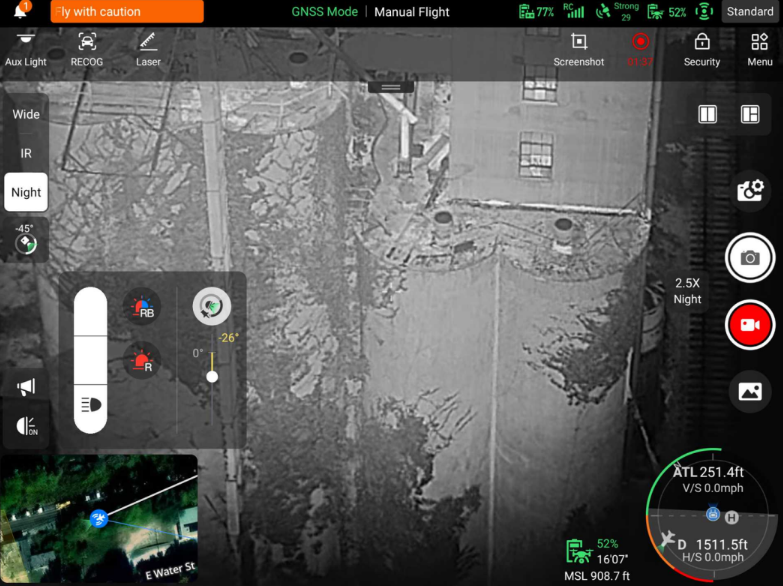
• Laser rangefinder and coordinate readout stayed usable with the spotlight running, returning ranges
past 2,100 ft with geographic coordinates on the target.
Figure 4 — Subject Acquisition
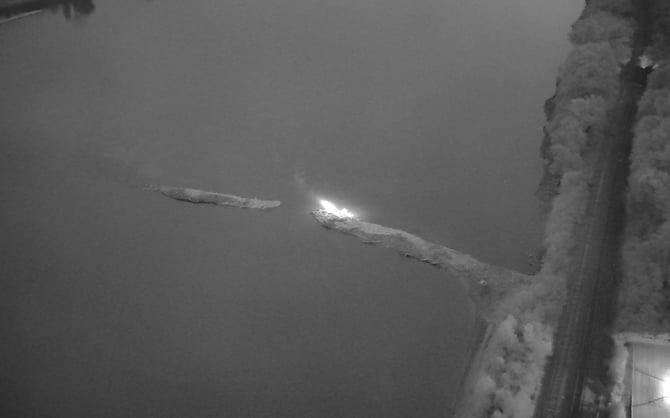
Starlight night sensor, spotlight on a mid-river sandbar at 365 ft AGL. Subjects were located on the night sensor first, then marked with the beam.
Figure 5 — Laser Range and Coordinates
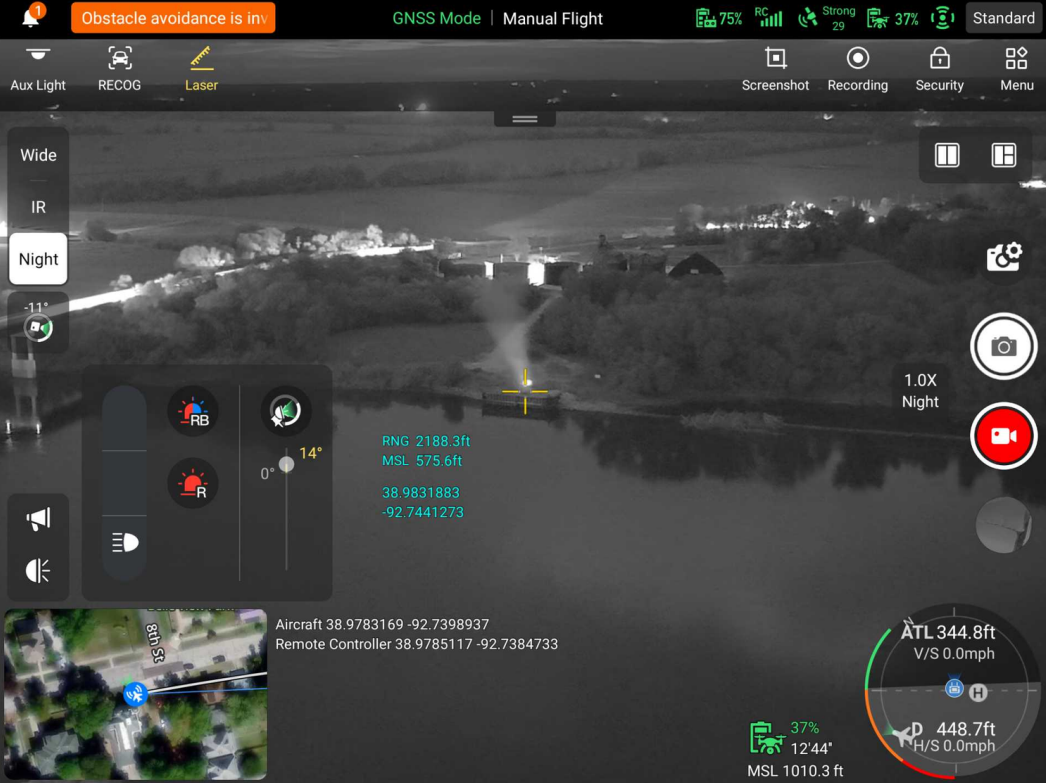
Rangefinder and geographic readout remain usable with the spotlight running. Range past 2,100 ft with coordinates resolved on the target.
5.2 What to Plan Around
• Sensor bloom is the main operational limitation. When the beam lands on a target, low-light sensors
bloom hard at the center of the beam and fine detail is lost until gain settles. Expect to lose a second
or two of usable detail at the moment of acquisition.
• Obstacle avoidance is unreliable in low light. The aircraft warns of this directly, and it is the single
most important item in a night crew briefing.
• The narrow beam is unforgiving at altitude. From several hundred feet AGL the lit circle is small
relative to the field of view, so a systematic search pattern is required — sweeping the light randomly
wastes flight time.
• Expect reduced endurance. Any powered top payload draws from the aircraft, and a 60 W light at
full output for extended periods will shorten a flight. Plan battery rotations accordingly.
• Bright point sources on the ground, including flashlights and headlamps carried by subjects, read as
intense hot spots on the night sensor and can be mistaken for the spotlight's own return.
Figure 6 — Thermal Cross-Check